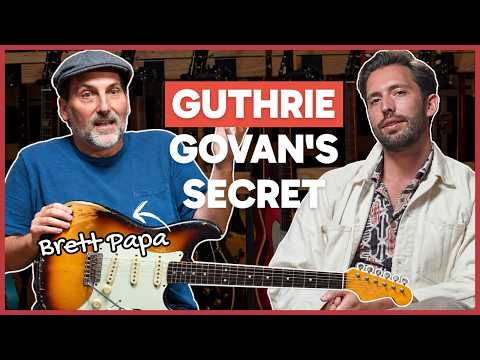
Jedd Hughes on Manifesting a Nashville Career, Writing With Guy Clark, and the Guitar Vince Gill Gave Him
PodcastFrom a Town of 800 People to the Grand Ole Opry
Some careers look like luck from the outside. Jedd Hughes' career looks like luck until you hear the details, and then it starts to look like something else entirely: relentless preparation meeting an obsessive, almost mystical clarity about what he wanted.
Sitting down with Spencer Handley at Carter Vintage Guitars for Playback Sessions, Hughes traced the arc from listening to Marty Robbins records as a kid in rural South Australia to standing on stage next to Vince Gill and Paul Franklin. Along the way there are lessons in preparation, songwriting craft, gear philosophy, and what it actually takes to build a musical life that does not feel like work.
The $800 Audition That Changed Everything
Hughes moved to Nashville on March 16th, 2002 with about $800 to his name, enough for a couple of months rent in an Antioch apartment. He knew exactly one person in town, songwriter Terry McBride, who had heard that Patty Loveless was looking for a guitar player and harmony singer.
He got an audition two weeks out. They gave him four songs to learn. Here is what he did instead:
"I went down to Fondulac's, which is an old record store here in town on Nolensville Road, and I bought every Patty Loveless record that they had, which was 10 records. And I went and learned every song from every record."
Two weeks of living and breathing one artist's catalog. Every song, every harmony part, every main riff. When Loveless asked at the end of the audition whether he knew anything else, Hughes could honestly say he knew all of it. She laughed out loud. Two days later her husband, producer Emory Gordy Jr., called and asked what he was doing Friday night. The answer turned out to be playing the Grand Ole Opry on a Lloyd Loar mandolin he did not even own yet.
The Takeaway for Players
Everybody says "be prepared for the gig." Almost nobody means learn ten albums when they asked for four songs. The gap between doing what is required and doing dramatically more than required is where careers get built. If you are auditioning for a band, a worship gig, a cover band, or a session, ask yourself what the version of this looks like for you. Learn the deep cuts. Learn the harmony parts. Learn the parts nobody expects you to know.
Hughes also noted something worth sitting with: after his audition he heard the next guy through the wall and thought, "That guy's really good. He'll probably get the gig." Preparation does not remove the nerves. It just means you have something to stand on when the nerves show up.
Writing Stories About Vince Gill Before It Happened
Long before Nashville, Hughes was a kid in South Australia writing stories about moving to Nashville and playing guitar with Vince Gill. Not journaling vaguely about "making it." Writing specific narratives about a specific outcome.
"Write it down. Talk about it. Really see it in your mind. Feel the experience or try to feel like what you think it's going to be like. And you can forecast your future."
He credits part of that intensity to isolation. In 1990s rural Australia, anything musical that crossed his path had enormous value because it was hard to find. Records were treasure. That scarcity created a kind of reverence that translated into focus.
There is a real lesson buried in there for modern players. Access is infinite now. Every lick, every lesson, every album ever recorded is one search away. The trade off is that nothing feels precious. If you want the kind of obsession that produces a career, you may have to manufacture the scarcity yourself: one album on repeat for a month, one player studied deeply instead of fifty studied shallowly.
How the Vince Gill Gig Actually Happened
Around 2016, Tom Bukovac got the call to tour with Joe Walsh, a childhood dream for a kid from Cleveland. Bukovac told Vince he could not do it and recommended Hughes, adding that he already knew all the music. Vince called. There were no rehearsals. Hughes got a song list, knew most of it already, and the first show was somewhere in the Midwest.
Note the mechanism there. The gig came through a peer who trusted him, and the recommendation was specifically about preparation. Your network is not a list of contacts. It is a list of people who know exactly what you are good at.
What Playing With Vince Gill Teaches You
Asked what he learned standing next to his hero night after night, Hughes gave a one word answer first: consistency.
"Vince Gill is one of the most consistent musicians I've ever been around. He's an incredible singer, an incredible guitar player, he has an incredible sense of timing and pocket and feel. When you're around that day in day out on a gig, that's a good thing to be around."
He described the band as operating like a room full of elite studio musicians, with everyone listening and self mixing in real time. That phrase, self mixing, is worth unpacking. It means each player is constantly adjusting their volume, density, and register based on what everyone else is doing, so the front of house engineer barely has to intervene. It is one of the most undervalued skills in ensemble playing and one you can practice at any level: play less when the vocal enters, move out of the register the keyboard just occupied, drop your volume when someone else steps forward.
The Songwriting Method: Detune One String
Hughes is building a songwriting course with Brett Papa aimed specifically at guitar players who can shred but freeze when it comes to writing. His core method starts with the instrument, not the page.
Create a Motif That Is Unique to You
His favorite trick for escaping muscle memory is deceptively simple: detune one string. On his song "Animal Eyes," he dropped the G string to F sharp and then spent weeks exploring how to move chords underneath while keeping certain notes static.
Why this works: your hands have deeply grooved pathways. Standard tuning shapes lead to standard tuning ideas. Change one variable and the familiar shapes produce unfamiliar sounds, which forces your ear to lead instead of your fingers. The resulting modal, third ambiguous voicings (neither clearly major nor minor) leave the emotional door open for a lyric to walk through.
Find One Nugget of Meaning
The second ingredient is a single meaningful spark: a title, a line, an image. For "Animal Eyes," the title came from his dog Rocco looking up at him on the couch. The opening line came from a phone call with Rodney Crowell where Hughes said he was "just crawling out of the morning," and Crowell immediately told him to write it down.
"If it's meaningful to you, then it has energy and you can work with that. That's just the first spark to get the thing going. Once it becomes something you care about, then you've really got something."
Play It Until It Tells You What It Wants to Be
Hughes says he lives with roughly five unfinished ideas at any given time, playing them constantly (and, he admits, annoying his wife) until they reveal their identity. He gets maybe one song a year that falls out fully formed in twenty or thirty minutes. Everything else is work, rewriting, and editing, which he says takes far more time than the original draft.
Practice Solo Writing and Co-Writing Separately
He makes a point that gets lost in Nashville's co-write culture: solo writing is a distinct skill, and it can atrophy. Collaboration gets you to a finished song faster because you have another perspective to edit against. But developing your own unfiltered voice requires time alone with the guitar. Hughes calls it a yin and yang and encourages the writers he works with to build both.
Bring What the Room Needs
He also tailors his contribution to his collaborator. With writers whose lyrical depth he admires, like Natalie Hemby or Matraca Berg, he shows up with strong melodies and lets them carry the words. Knowing what you bring, and who you bring it to, is its own craft.
Guitar Party: One Song a Day
The trio project with Tom Bukovac and Guthrie Trapp came out of a low moment. Hughes was playing a solo show at 3rd and Lindsley in a genuinely dark headspace, telling himself it would be the last solo show he ever played. Then Tom and Guthrie walked in the back door, got up and played with him, and the entire night turned around.
Their writing process is worth stealing. The three keep a running text thread of voice memos: riffs, sections, chord changes, anything worth tracking. When something resonates, someone writes a companion section. In the studio, they sit around a kitchen table with acoustic guitars, pick one idea in the morning, flesh out the arrangement and structure, then walk into the tracking room and build the record that same day. One song per day, start to finish.
The lesson for home recordists: constraints produce output. A deadline of one day per song forces decisions and prevents the endless tinkering that kills so many projects.
Gear Philosophy: Know a Few Things Deeply
Hughes gets gear questions constantly and his answer is refreshingly unfashionable. He quotes Daniel Lanois: you do not need a lot of gear, you need a couple of things you really know how to use.
His actual rig:
- An Electro-Harmonix Memory Man he has owned for nearly 25 years, on every pedalboard he has ever built
- One fuzz pedal that has worked with his hands for years
- A 1964 Deluxe Reverb and a 1959 Tweed Deluxe as his two main amps, chosen partly because they are easy to keep running
- A B Bender parts Telecaster he built during the pandemic
- A De Gruchy dreadnought (D-45 style, abalone, Brazilian rosewood) he has had for over 20 years
No modelers, no Neural DSP rabbit hole. Three young kids and no interest.
"Don't spend more time on reverb than you do working on your song today."
Or, as Guy Clark used to tell him, they are just tools.
Ten Years at Guy Clark's Workbench
Hughes met Guy Clark in 2002 and wrote with him for roughly a decade. He says he is still learning from those sessions, still occasionally remembering a conversation and extracting something new from it. One of those old songs finally surfaced on his 2025 record Night Shades, made partly in his Austin garage during the pandemic and finished with Rodney Crowell.
That is a useful reminder for anyone sitting on unfinished material. A song written twenty years ago is not expired. Hughes still has unreleased Guy Clark co-writes in a drawer.
On AI, Suno, and Where the Next Generation Learns
Hughes does not use AI in his process, but he has started encountering it in the studio. On a recent record, every demo played during the process was generated with Suno. He did not clock it at first and genuinely thought the demo singer was good enough to have a career.
"This is really good. But I don't care about it. And why don't I care about it? Because it doesn't have a human element. Nothing about it is going to stick with me."
His deeper concern is structural and specific to Nashville. He learned his craft playing demo sessions, developing his ability to contribute parts to recordings in a low stakes environment. If AI replaces the demo, the training ground disappears.
"If that goes away, where are the next crop of session players going to learn their craft?"
He is cautiously optimistic about the long arc, predicting the pendulum swings back toward the human element the way people eventually rejected processed food. But he is clear eyed about the intermediate damage.
The Guitar
At eleven years old in Australia, Hughes had a Sony music sampler cassette where every track was forgettable except the last one: Danny Gatton's "Sun Medley." He wore the tape out rewinding it and became a lifelong fan.
Roughly thirty years later he walked into Vince Gill's house and spotted an ES-350 across the room that looked exactly like the one Gatton played on Austin City Limits. It was. Vince told him to play it, and Hughes used it on tracks for Vince's new music.
A few months before this interview, Vince left him a voicemail asking him to come by the house. He pulled out a brown Gibson case, opened it, and told Hughes he should have it.
"I just stood there. I didn't know what to say. I just started crying. I think the first thing I said was, are you sure?"
Vince's answer: "I'll never forget the first time you saw that guitar and I know what it means to you." Hughes now takes it to every session and has been digging deeper into that hillbilly country jazz vocabulary.
What Hughes Is Working On Right Now
Even after decades of professional work, he is filling in gaps. He has relied on his ear for so long that he knows chords he cannot name. So he is actively studying theory: playing a voicing, realizing he does not know why it is called a half diminished, then hunting down the answer and deconstructing the notes.
There is something clarifying about a player at his level admitting that and doing the unglamorous work anyway. If you have been avoiding theory because you think it is too late or too dry, this is your permission slip.
Five Things to Take Into Your Practice This Week
- Over prepare for the next opportunity. Whatever the requirement is, quietly triple it.
- Detune one string and write. Drop the G to F sharp and spend twenty minutes finding voicings that keep notes static while chords move underneath.
- Start a voice memo thread. Capture every riff and fragment. Send them to two trusted friends and see what resonates.
- Write one song alone. No co-writer, no shortcuts. Treat solo writing as a distinct muscle.
- Audit your gear. Pick two or three pieces you will genuinely master this year and stop shopping for the rest.
The through line in Hughes' story is not talent, though he clearly has it. It is that he decided early and specifically what he wanted, then did more preparation than anyone asked for, then kept saying yes to work that genuinely resonated with him until the work started feeding itself. That last part is the payoff. Asked how much of his schedule feels like a job now, his answer was simple: not much of it really feels like work anymore.
Continue exploring
Insights from our community of musicians, mentors, and students.